NEWS CENTER
Why Do Large-Silo Inventory Figures Fail to Reconcile? A 3D Imaging Approach to Volume, Weight and Inbound/Outbound Control
Huachuang measurement and control Huachuang measurement and Control Technology Co., Ltd 2026-09-21 16:39
In grain, feed, coal, cement, building-material, metallurgy and power-generation operations, inventory figures support production scheduling, replenishment, delivery and financial reconciliation. A common limitation is that one radar or other level instrument measures the distance at one installation point, while the material surface may change significantly because of the filling direction, impact of incoming material, angle of repose, collapse or local bridging. A stable reading at one point does not prove that the total material volume or inventory is stable. When the material is unevenly distributed, estimating total inventory from one point can create a persistent gap between measured stock and inbound/outbound records.
Manual measurement is also affected by silo height, dust, moisture, continuous operation and personnel-entry risks. Frequent shutdowns or silo clearing interrupt production and make stocktaking periodic and delayed, which reduces the chance of identifying off-centre piles, local voids or abnormal inventory changes in time. A more practical reconciliation process should first define whether the operation needs average level, material volume, weight or regional inventory changes. The project should also collect the number and dimensions of silos, material type, surface profile, filling and discharge arrangements, dust and moisture conditions, existing weighing or metering data and the outputs required by the inventory-management system.
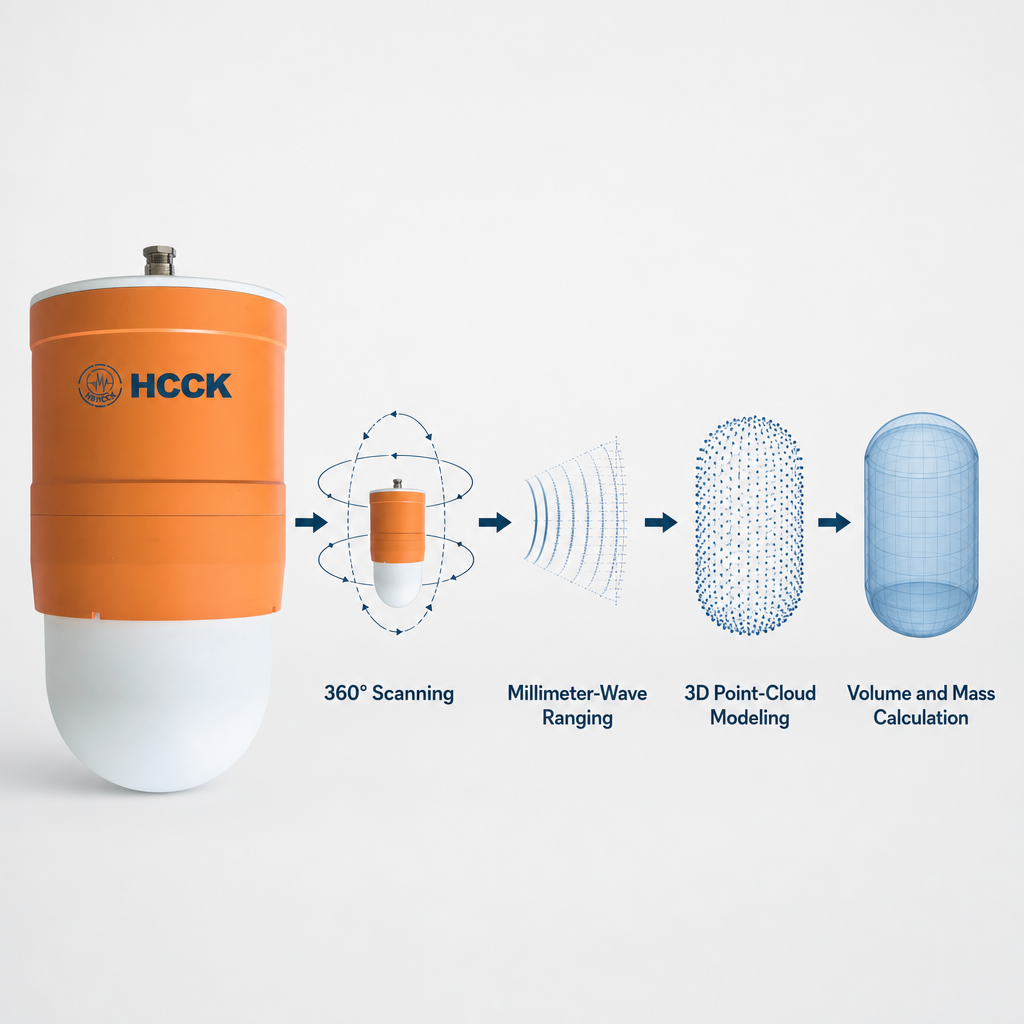
HCCK HCDAR-3D uses horizontal 360° rotation and vertical pitching to scan the material surface throughout the silo. At each preset angle, the device transmits microwave signals and receives the reflected signal, calculating the material distance from the round-trip travel time. The large set of angle and distance data is then converted into three-dimensional coordinates and a point-cloud model. Instead of seeing only one level value, operators can view the surface undulation, off-centre accumulation and spatial distribution of the material.
For inventory management, the 3D model can provide a visual representation of the material shape and automatically calculate material volume, weight or mass, and average level. HCDAR-3D provides online continuous imaging, no shutdown required for silo clearing, dust and moisture resistance, layered and regional density measurement, and AI-algorithm-enabled measurement. For plants that need continuous visibility of stock changes, this moves stocktaking from occasional manual measurement toward continuous material-surface data followed by scheduled reconciliation. Actual weight results should still be confirmed against material density, silo calibration and the project’s weighing conditions; the visual model alone should not be treated as a financial inventory value.
HCDAR-3D is intended for volume, weight and monitoring applications in large facilities such as grain factories, feed mills, coal yards, cement plants, power plants and building-material factories. Its industry coverage includes grain, feed, metallurgy, mining, coal mining, cement, building materials, power generation and waste treatment. The value of the solution is not simply replacing one point level instrument. It brings surface shape, regional distribution and volume calculation into one inventory data chain, providing a more complete measurement basis for identifying off-centre accumulation, reconciling inbound and outbound material and supporting production traceability.
The first step is to define the stocktaking scope and data rules. Decide which silos require continuous monitoring and which require periodic surveys, and whether the management target is average level, total volume, weight or layered and regional data. The second step is to match the installation arrangement with the silo model. The project should provide the silo structure, effective capacity, roof space, filling and discharge positions, material name, density variation and dust or moisture conditions. The installation position should cover the material area that must be managed and avoid fixed structures that obstruct the scanning path. The final mounting arrangement should be confirmed against the silo structure and site conditions.
The third step is to compare 3D measurement results periodically with weighbridges, belt scales, flowmeters or warehouse ledgers. This helps separate measurement deviation, density changes, conveying losses and ledger delays instead of treating all differences as an instrument fault. In multi-silo production, stock changes can be reviewed by silo, material batch and time period, allowing abnormal changes to trigger a targeted manual check before the monthly inventory close. HCCK can further evaluate whether the scan coverage, model configuration, regional analysis and management outputs of HCDAR-3D match the project after reviewing the number of silos, material properties, inventory objectives and available data interfaces. Accurate inventory in large silos depends on coordination between 3D measurement, material parameters, weighing equipment and management procedures.
For professional support, visit our Website at www.hhcck.cn/, contact our team via WhatsApp: +86 195 3225 4537, or Email: sales@hhcck.com.


South of Puhui Street, west of Guangsheng East Road, High tech Zone, Fengnan District, Tangshan City, Hebei Province





Technical support:

Tips
Submitted successfully
Back Index