NEWS CENTER
How Industrial IoT Cloud Platforms Achieve Centralized Level Monitoring for Tanks and Silos: Multi-Protocol Ingestion, GIS SCADA, and Instant Alarm Selection Guide
Huachuang measurement and control Huachuang measurement and Control Technology Co., Ltd 2026-11-13 10:01
Across petrochemical tank farms, municipal water supply networks, bulk grain logistics hubs, livestock feed silo complexes, power plant desulfurization/denitrification systems, and decentralized wastewater treatment facilities, storage vessels, silos, and sumps are inherently characterized by broad geographical dispersion, large unit counts, and heterogeneous field instrumentation interfaces. Under traditional decentralized monitoring architectures, industrial plant operations face critical operational bottlenecks. First, field-deployed 80GHz/26GHz radar level meters, ultrasonic level sensors, pressure/differential pressure transmitters, submersible hydrostatic level probes, and RF admittance level switches utilize diverse electrical output protocols ranging from 2-wire 4–20mA analog loops and RS485 Modbus-RTU serial links to Ethernet Modbus-TCP, dry contact alarms, and proprietary PLC protocols. Conventional standalone SCADA workstations and isolated human-machine interface (HMI) panels struggle to parse and integrate these heterogeneous protocols seamlessly, creating isolated "data silos" across individual workshops and regional facilities. This fragmentation prevents dispatching centers and plant management from accessing unified, real-time inventory and continuous process data. Second, manual gauge reading and climbing inspections demand excessive labor while exposing technicians to severe occupational hazards, including flammable atmospheres, toxic gas emissions, and high-altitude falls; furthermore, delayed data updates cannot capture dynamic level surges. In addition, traditional systems lack multi-channel notification mechanisms. When overfill spillage, pipeline ruptures, silo bridging, or sensor communication dropouts occur, isolated local sirens frequently result in unacknowledged alarms and delayed countermeasures, creating substantial material loss and environmental liability.
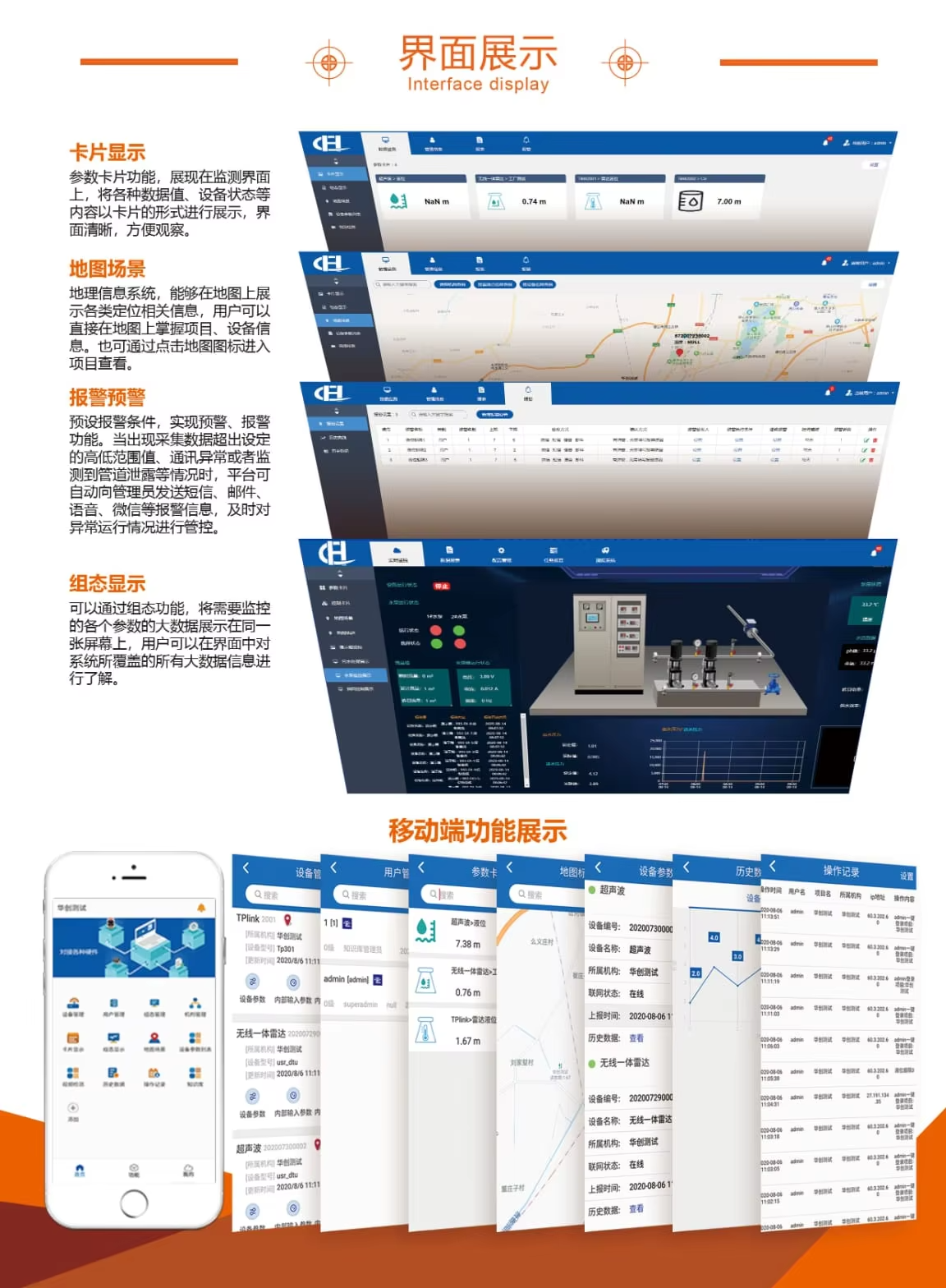
To eliminate protocol barriers, bridge data silos, and elevate operational safety, industrial plants require an integrated Industrial Internet of Things (IIoT) cloud-based centralized monitoring system combining intelligent edge data ingestion, broad network compatibility, robust local interlocking control, web-based SCADA visualization, and multi-channel instant alarm dispatching. During project engineering and system planning, instrumentation specialists and system integrators must systematically evaluate sensor electrical interfaces, physical network topologies across cellular and localized RF frequencies, edge control reliability, cloud-tier concurrent data throughput, and hierarchical cybersecurity access rights. Uniting plug-and-play IoT hardware integration, autonomous local control panel stability, zero-code B/S SCADA dashboard deployment, and closed-loop multi-channel alerting establishes the essential engineering foundation for fine-grained, transparent, and intelligent plant inventory management.
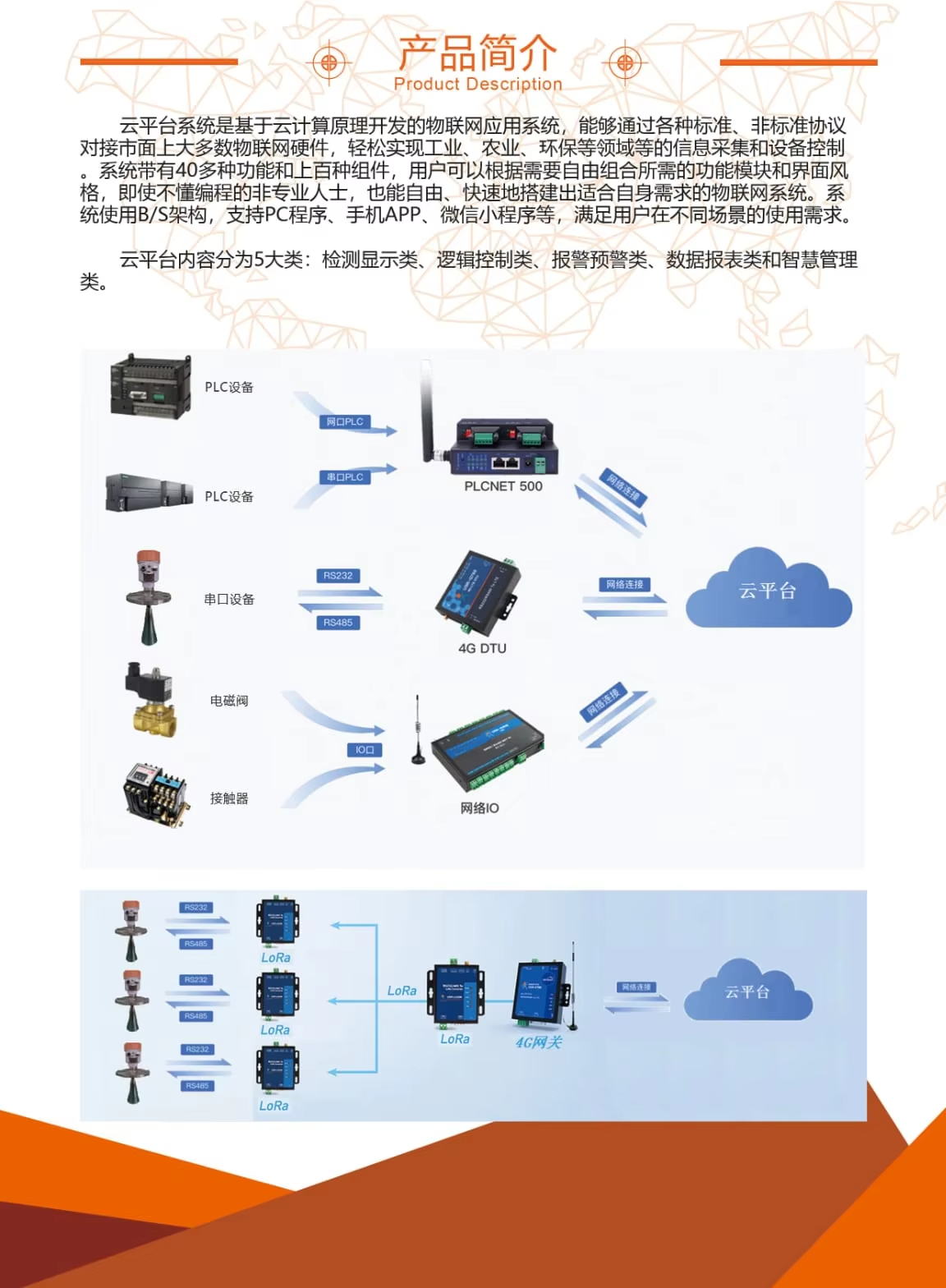
To resolve multi-site level monitoring challenges, HCCK delivers an integrated IIoT Cloud Platform and On-site Centralized Management System combining advanced hardware gateways and cloud software. At the physical ingestion and network transport tier, the architecture deploys a comprehensive industrial connectivity matrix: for isolated standalone vessels and remote hydrological monitoring stations with reliable cellular coverage, industrial-grade 4G DTU modules provide plug-and-play transparent data transmission directly to the cloud; for densely arranged tank clusters or hazardous areas with heavy structural shielding, a star-network topology combining "low-power LoRa wireless sensor nodes + LoRa 4G centralized gateways" significantly reduces cabling costs while providing superior signal penetration across complex metallic environments; for process plants equipped with established PLC systems (such as Siemens, Mitsubishi, and Omron), PLCNET 500 Ethernet/serial gateways and network I/O modules execute non-intrusive mirror data acquisition from PLC registers, Modbus smart meters, and digital I/O channels without disrupting primary process control loops. At the local control edge, an on-site centralized management cabinet—integrating PLCs, industrial touchscreens, signal isolation modules, and regulated DC power supplies—renders real-time level trends, vessel inventories, and pump/valve operating states via high-refresh animated graphics, ensuring autonomous local interlocking safety even during public network outages.
At the cloud analytics and presentation tier, the HCCK Cloud Platform is engineered on a high-concurrency B/S architecture, natively supporting PC browsers, dedicated mobile APPs, and WeChat mini-programs. Featuring over 40 functional modules and hundreds of pre-engineered graphical components, the platform enables rapid zero-code construction of customized digital twin SCADA dashboards across five primary capability domains:
Monitoring and Visualization: Integrates high-precision GIS electronic mapping to display geographical coordinates across distributed facilities with single-click drill-down to individual tank parameter cards; provides flexible 2D/3D dynamic SCADA editors to model realistic process flow diagrams, fluid piping animations, and live video surveillance integration;
Logic Control: Under multi-layer encryption and strict authentication, enables remote pump start/stop control, motorized valve positioning, process setpoint adjustments, scheduled automated alternation, and cross-gateway multi-device interlocking;
Alarm and Pre-warning: Allows operators to configure high/low limit thresholds, rate-of-change deviations, fluid leakage spikes, and communication timeout rules; when triggered, the platform instantly dispatches alert notifications across four simultaneous channels—SMS text, instant messaging, voice phone calls, and email—establishing a closed loop from event detection to operator verification;
Data Analytics and Reporting: Automatically archives historical level and process parameters, generating multi-timeframe trend curves, comparative bar charts, and distribution pie charts; exports automated shift, daily, and monthly compliance reports to Excel, providing verified data for material inventory balancing and energy auditing;
Intelligent Asset Management: Implements hierarchical enterprise permission structures, digital equipment health ledgers, communication driver management, electronic inspection task routing, and maintenance logging to accelerate digital plant transformation.
When planning and deploying the HCCK Industrial IoT Cloud Platform and on-site centralized management system, engineering teams must adhere to standardized selection criteria and field installation practices to guarantee 24/7 reliability across harsh industrial environments. Regarding communication topology selection: for widely dispersed vessels with robust cellular coverage, deploying 4G DTUs directly on individual instruments minimizes intermediate single-point failure risks; for compact tank farms or explosion-proof zones, LoRa wireless mesh networks should be specified, with gateway antennas mounted at elevated, unobstructed positions and protected by high-grade lightning surge arresters. For instruments in hazardous classified locations, signal cables routing into centralized cabinets must pass through certified intrinsically safe barriers or flameproof junction boxes in strict compliance with hazardous area electrical standards. Regarding power infrastructure, continuous process plants should provide 24VDC centralized industrial power or 220VAC mains; for remote open-air sumps, raw water reservoirs, or off-grid storage yards, custom low-power solar photovoltaic systems with battery storage and smart device sleep/wake routines ensure uninterrupted autonomous operation through extended overcast weather.
When consulting with HCCK application engineers for tailored IoT level monitoring solutions, project teams should provide the following baseline operational parameters:
Facility layout and vessel spatial distribution: Geographic plant locations, total count of storage tanks/silos/sumps, vessel geometry (diameter and height), physical line-of-sight distances between nodes, and structural obstructions;
Field sensor configuration and communication interfaces: Specific models of installed or planned radar level meters, ultrasonic transmitters, and pressure sensors, including output signal formats (such as 2-wire 4–20mA, RS485 Modbus-RTU, or dry contacts) and communication baud rates;
Power supply availability and network infrastructure: Local power options (220VAC mains, 24VDC centralized bus, or off-grid solar systems), cellular 4G signal strength at sensor locations, and local industrial Ethernet availability;
Control automation logic and alarm routing: Requirements for local touch panels, remote valve/pump interlocking logic, alarm threshold configurations, alert contact lists (designated personnel for SMS/voice/email dispatches), and multi-tier organizational permission hierarchies. HCCK’s digital engineering specialists will configure an end-to-end customized solution encompassing IoT data gateways, electrical cabinet schematics, and interactive 3D cloud SCADA dashboards tailored to your operational requirements.
For professional support, visit our Website at www.hhcck.cn/, contact our team via WhatsApp: +86 150 2761 6330, or Email: sales@hhcck.com.


South of Puhui Street, west of Guangsheng East Road, High tech Zone, Fengnan District, Tangshan City, Hebei Province





Technical support:

Tips
Submitted successfully
Back Index