NEWS CENTER
Irregular Material Surfaces in Coal Bunkers and Clinker Silos? Millimeter-Wave 3D Scanner Inventory Solution
Huachuang measurement and control Huachuang measurement and Control Technology Co., Ltd 2026-11-16 10:01
In thermal power generation, cement manufacturing, metallurgy, coal mining, and bulk grain logistics facilities, raw coal bunkers, clinker domes, limestone homogenization silos, and vertical storage silos serve as mission-critical reserves maintaining continuous production. However, during daily dispatching and inventory audits, plant operators persistently struggle with the challenge of bulk solids being "unmeasurable, invisible, and inaccurate." First, industrial bulk silos typically feature wide diameters exceeding 20 meters and significant vertical depths. During multi-point filling, chute discharging, and gravity-fed drawdown cycles, bulk particulate solids develop highly complex, irregular surface topologies driven by grain size distribution, moisture variation, and natural angles of repose—including eccentric pile slopes, localized drawdown cones, deep rat-holes, and hazardous bridging voids. Conventional single-point instruments, such as standard radar level meters, ultrasonic sensors, or plumb-bob level indicators, only capture a single distance value along a narrow vertical line directly beneath the sensor. If a single point strikes a filling peak, the control system mistakenly assumes the vessel is full and halts feeding prematurely, wasting valuable storage capacity; conversely, if the beam measures into a drawdown funnel, the system issues false low-level alarms or conceals severe bridging blockages, leading to sudden fuel starvation in power plant boilers or rotary cement kilns. Second, bulk silos are characterized by dense airborne dust clouds, tumbling vapor, and hazardous confined spaces. Traditional manual dip-tape measurements or portable laser surveys present critical safety risks, including dust inhalation, structural falls, and material engulfment, while requiring complete operational shutdowns. Consequently, manual audits remain infrequent and delayed, perpetuating persistent discrepancies between ERP financial ledgers and real physical inventory.
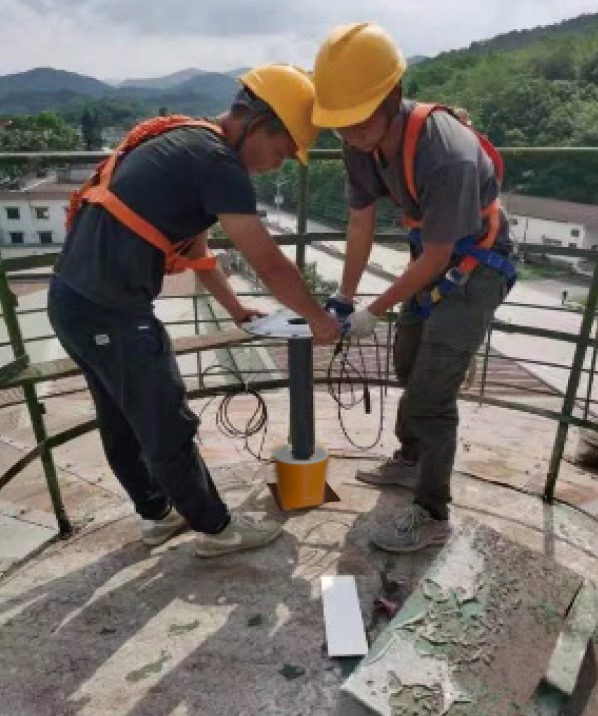
To eliminate the blind spots of single-point level gauges and the safety hazards of manual stocktaking, bulk handling facilities must transition from crude single-point distance estimation to comprehensive 3D surface modeling and dynamic volume integration. During preliminary project planning, instrumentation engineers must systematically evaluate facility operating boundaries: including silo geometric profiles (flat-bottom cylindrical silos, tall vertical bunkers, rectangular covered stockpiles, or multi-hopper cones), physical material characteristics (particle size distribution, bulk density variations, flowability, angle of repose, and dust concentration), feeding/discharging operational cycles (conveyor trajectories, feeder sequencing, and maximum surface elevation drop), and automation network integration protocols. Combining non-contact full-surface 3D point-cloud scanning, spatial micro-element volume integration algorithms, multi-region density dynamic compensation, and Industrial IoT SCADA dashboards establishes the definitive engineering path to achieve transparent, real-time bulk asset management while safeguarding uninterrupted production.
To resolve the measurement failures caused by severely irregular material profiles, blinding dust, and single-point blind spots in large coal bunkers and clinker silos, HCCK delivers the HCDAR-3D Millimeter-Wave 3D Level Scanner, purpose-built for bulk solids inventory management. The instrument incorporates a high-precision dual-axis motorized scanning gimbal and a high-frequency Frequency Modulated Continuous Wave (FMCW) radar transceiver. Mounted on the silo roof, the scanner executes 360° continuous horizontal rotation paired with wide-angle vertical pitch articulation, sweeping fine-mesh microwave beams across the entire internal material topography. Operating at millimeter-wave frequencies, the radar signals possess exceptional penetration and noise immunity, easily traversing dense airborne dust clouds, vapor, and turbulent air currents. At thousands of discrete spatial coordinates per cycle, the scanner transmits and receives return echoes, calculating exact spatial coordinates via nanosecond-level electromagnetic Time-of-Flight (ToF) processing.
At the data analytics and surface reconstruction tier, the integrated high-speed industrial microprocessor converts tens of thousands of raw polar coordinate measurements into a high-density 3D Point Cloud topological mesh in real time. Moving beyond simplistic single-distance readouts, the HCDAR-3D transforms the dark, enclosed silo interior into an intuitive, high-resolution 3D digital twin model, clearly visualizing peaks, valleys, off-center slopes, draw-down craters, and structural bridging. Powered by advanced spatial micro-element volume integration algorithms, the HCDAR-3D automatically deducts internal structural obstructions and dead zones, continuously outputting true bulk volume, total mass (weight), maximum level coordinates, minimum level coordinates, and vessel-wide average level height. Furthermore, the instrument supports non-intrusive online continuous scanning without requiring process shutdowns, incorporating smart multi-layer and regional bulk density algorithms that compensate for compressive density variations in deep silos. For system integration, the HCDAR-3D natively interfaces with industrial Ethernet, RS485 Modbus networks, and the HCCK Industrial IoT Cloud Platform, streaming 3D volumetric models and inventory data directly to plant DCS, centralized control consoles, and enterprise ERP/MES software to empower precision recipe batching, automated replenishment, and real-time inventory reconciliation.
When deploying the HCCK HCDAR-3D millimeter-wave 3D scanning system across large cylindrical silos, deep bunkers, and covered material halls, rigorous mounting location planning and field commissioning are vital to ensure point-cloud integrity and volumetric calculation accuracy. For medium-sized cylindrical silos (typically under 15 meters in diameter) free from heavy internal obstructions, installing a single HCDAR-3D scanner near the roof center achieves 100% surface scanning coverage. However, for large-scale clinker domes, thermal power plant raw coal bunkers, or rectangular storage halls exceeding 20 meters in diameter, a single scanner's line-of-sight can be obstructed by roof trusses, internal beams, or steep sidewall shadows. In such applications, an arrayed multi-scanner configuration deploying 2 to 4 synchronized units across the roof is specified. Utilizing HCCK’s proprietary multi-sensor spatial fusion algorithms, discrete point-cloud streams are aligned, filtered, and seamlessly stitched into a unified, high-accuracy composite 3D model, eliminating all blind zones. Mechanically, the mounting flange must be rigidly secured to ensure vibration resistance, with the antenna extending flush past the bottom of the installation nozzle and positioned safely away from direct conveyor feed chutes.
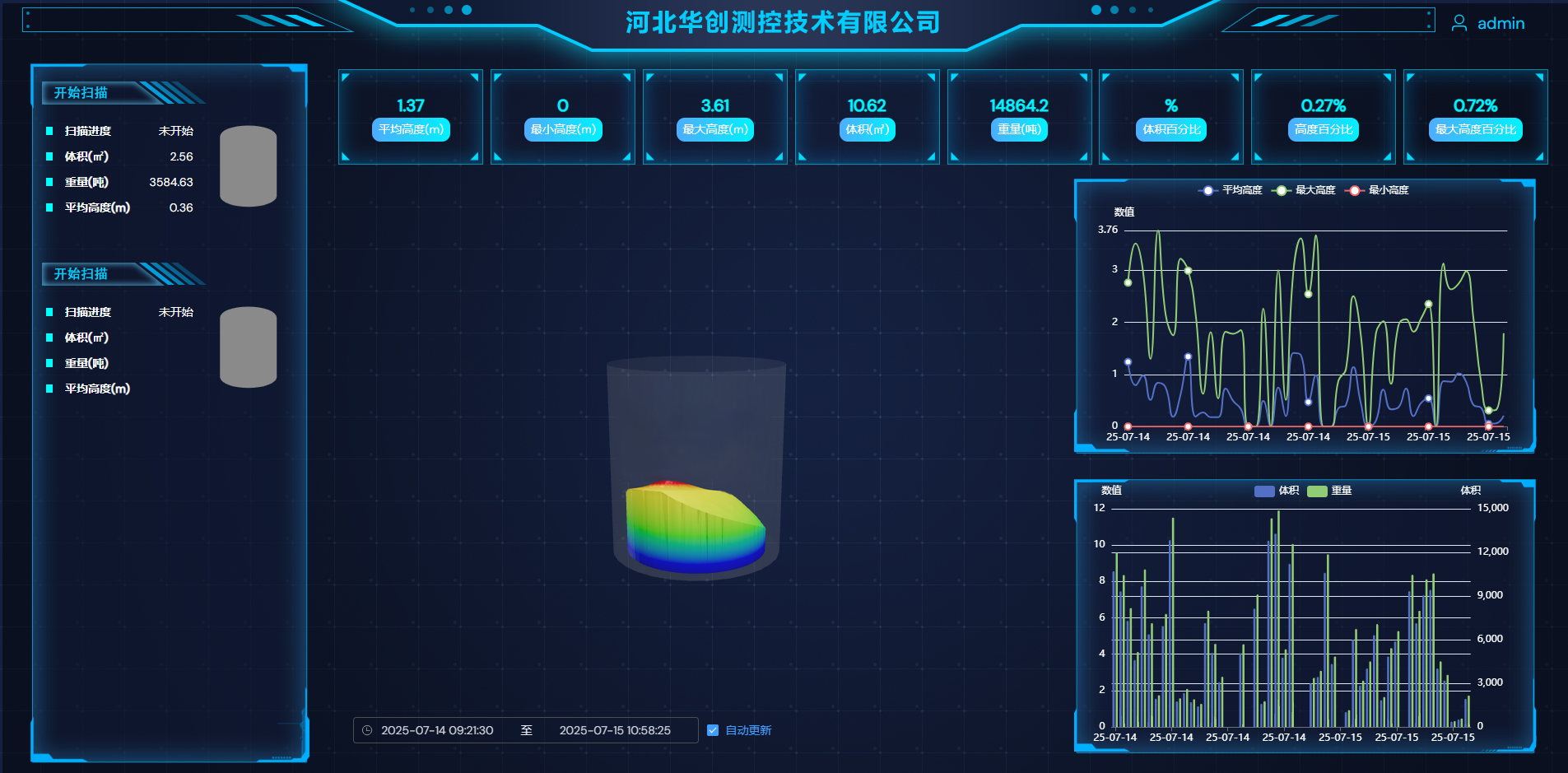
During software commissioning, application technicians import the vessel's geometric CAD dimensions (including internal diameter, cylinder height, bottom hopper taper angles, and discharge opening positions) to establish empty-silo calibration and geometric zero baselines; bulk density calibration matrices are then configured to match the specific material grades. For multi-site industrial enterprises, centralized dashboards on the HCCK Industrial IoT Cloud Platform aggregate vessel inventories across plants, establishing automated alarm thresholds for high-level overfill prevention, low-level starvation warnings, and structural load imbalance alerts caused by severe eccentric buildup. When consulting with HCCK application specialists for tailored 3D bulk scanning solutions, project teams should provide the following baseline operational data:
Silo geometric structure and engineering drawings: Vessel category (cylindrical silo, square bunker, rectangular hall), diameter/dimensions, vertical height, hopper discharge geometry, and internal obstruction layouts;
Material physical properties and process parameters: Material chemical/common name (such as raw coal, cement clinker, limestone, synthetic grain), particle size distribution, bulk density variations, natural angle of repose, and operating temperature/moisture conditions;
Feeding and discharging logistics: Number and locations of fill ports and discharge gates, feeding frequency, airborne dust severity, and required explosion-proof classifications;
Control system and electrical interface requirements: Desired data output formats (real-time 3D point cloud, volume, weight, average level, peak/valley alarms), communication protocols (Ethernet TCP/IP, RS485 Modbus), and cloud telemetry preferences. HCCK’s senior instrumentation engineers will deliver a customized installation layout, hardware configuration bill of materials, and a turn-key 3D digital twin inventory solution tailored to your facility.
For professional support, visit our Website at www.hhcck.cn/, contact our team via WhatsApp: +86 150 2761 6330, or Email: sales@hhcck.com.


South of Puhui Street, west of Guangsheng East Road, High tech Zone, Fengnan District, Tangshan City, Hebei Province





Technical support:

Tips
Submitted successfully
Back Index